Concluding Palo Verde pt 2

Christian has returned safely to us and we traveled to San Jose.

Somewhere on the internet there is a photo of me with the University of Northern Colorado researchers Ann Elizabeth and Meagan, who will finish their time in Palo Verde National Park. It will be sad to not see them until I return to Colorado but it was time to move on.

The midterms were difficult but rewarding and the revision of the scientific paper was terrifying! I am content with how it all went.
We are in San Jose until April 4th.

Concluding Palo Verde. Part One

As the the waters of the marshland here in Palo Verde recedes for the remainder of the dry season it will ultimately force insects to leave for the season, crocodiles to retreat to the Tempisque river, and signal the end of our stay at the station. We have faced some of the hardest challenges so far here, I am not shy so say I have been reconsidering all the time if I am truly strong-willed enough to face the challenges we are presented as biologists, fragile humans, and citizens in a changing planet.

“What doesn’t kill you makes you stronger” Unless it is a research paper that was conceived and turned in a twenty-four hour period, a sobering personal statement by long-term researchers on how much harder it is to find their study animal with the passing seasons, or a dangerous animal that you know is only scared and defending itself the only way it knows how. I was told thick skin is necessary to face the rejection letters ecologists are going to receive several times over a career. But the truth is I am a fragile creature, and all creatures are fragile.

Our first Independent Project was, in my opinion, a success and a big sigh of relief. The time from me wanting to study human development’s impact on protected areas and Bridgett Gross of The College of Wooster(Ohio) wanting to learn more about ants and acacia trees to presenting a research proposal with a hypothesis and complex methods was a time period of about 15 hours. Additionally, we had a four day time period to collect data, and the temperature was at 102F at 9am every morning. I was really stressed out for a day because I did not understand how to use our statistical analysis program, until I calmed down and realized my professor didn’t know it well either and worked with us through using it. After we analyzed our data and answered our ecological questions we had at the beginning of the week my partner and I had about another 24-30 hour period to write up our individual research papers and complete, practice, revise, and present our Powerpoint presentation. I now have two biological/scientifically formatted papers under my belt!

I do not really remember what we even did here in terms of lectures and field trips, but we have two midterms on these things in two days. I was supposed to be studying plant and insect taxonomy as well, but I am only really an expert on mutualistic plants and ants.

Today is our first free day in two weeks, but no one is getting any rest today. By next week we will be back in San Pedro, and I will be with my Home-stay family. They are Cecilia and Carlos Ramirez-Gutierrez, a homemaker and sales agent. My classmates will be with separate families, from physical therapists to bakers. I look forward to a break from biology.
Cuerici(From Feb10-14th)

Costa Rica’s high altitude climate is actually home to oak-dominated forest. This particular site was a private research station on the pacific slope operated by hunter and logger turned mountaineer and naturalist Don Carlos. It was incredible to see this after coming from La Cruces, a lower elevation wetter forest. We lived in the clouds, literally!

This site is subject to the same dangers as any tropical forest, where selective logging and apathy for a less iconic forest has made it a difficult ecosystem to inspire conservation practices in. The area is home to high altitude bamboo, which blooms on a 15 year cycle. Migratory birds attract bird enthusiasts(birders) and the bamboo then dies and restarts its cycle.

Higher up than the oak forest is the Paramo(Approx. 2800-3000meters), which I can best describe as sub alpine. Plants here are shrubs and stay low to the ground to encourage a wind boundary and also adapt to intense sunlight. However, our nature walk on the paramo was in fact during a wet storm system and we could only image walking over the continental divide and seeing both the Pacific and Atlantic oceans from one standing position. Our second day was much brighter and we traveled to a different location, spending time viewing the pacific.

We were unable to stay too long however, and before we could settle in we arrived in Guanacaste province.

Week 2: Neat Coffee plantation and ant survey

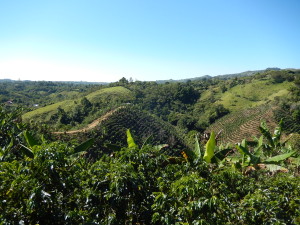
This weekend was a participation in a genuine long term study of Shade vs. Sun Coffee plantations here in Costa Rica. For anyone who enjoys coffee and low prices, this is an important study. First I will begin by telling you all that I visited a coffee plantation for the first time ever and learned the secret ways of harvesting, drying and roasting the coffee bean. La finca de Don Roberto is a modest subsistence farm with sugar cane, cerro, pollo, and yucca. Coffee plants dominate the 3 hectares of his 6.5 hectare property. Coming onto the property is like stepping into the past. The front porch is the dining room and gourds and rusted farm tools hang from the ceiling. We receive a warm welcome from a man who grew into his farm. He was warm and welcoming to the gringo students and even lets researchers stay on his farm to research. Our favorite piece was the mutt that picked bananas for itself and loved getting its ear scratched!

Coffee is naturally an understory plant and Don Roberto grows his plants under banana trees and natural forest. He has successfully created a terrace system and irrigated the land to minimize erosion. The soil was dark in color, indicating its high nutrient value. It was a peaceful place, and old-time Latin music was playing nearby and children from the community, maybe grandchildren, played by the house and did chores. He is content to spend his life restoring fragments of natural forest on his land and enjoying seeing his grandchildren become interested in the outdoors; he finds modern technologies have created a barrier between people and the land. I would like to visit him again.

Our project was to help a researcher from El Universidad de Costa Rica count and identify species of ants and coffee boring beetles. We spent our first day at Don Roberto’s, a shade plantation, and the next day at a commercial sized sun plantation.DSCN0888 We started our survey by putting out tuna bait for carnivorous ant species and collected the ants that appeared after forty minutes. My survey site was at the far end of the plantation. I was required to crawl prone through a patch of coffee plants, placing baits along the way. Additionally, we collected 250 fallen coffee fruits to dissect later for evidence of beetle investation. When I came out of the tunnel I was greeted to a vista of the entire plantation, it was a moment of peace and reflection, because every piece of land and pasture was once old growth forest with wet soil and vibrant life. After collection we returned to el labortorio at la cruces and worked at identifying the genus of ant and sifting through our coffee beans and fruits. I am proud to be apart of real work that determines the livelihood of farmers here, and I will be involved in more projects later on in the semester.

Week 1: La Cruces Biology

An overall recap of the events of La Cruces. Our classeroom is in Casa Wilson.

We began our lessons with an overview of safety and risk mitigation while we where here. Our first lecture was called “Dangerous and annoying creatures” Bottom line, use common sense if you want to not get messed up out here. Sometimes however, common sense is overridden by our overall excitement. I should never have told my classmates I was EMS certified, I have been the “lifeguard” of the group once so far.

Out in the rain forest, always bring a flashlight, it is quite dark in the understory during the day and the sun sets at 6pm. The most dangerous things out here are either self-induced or microbial. Drink water a lot. Don’t let mosquitoes bite, but you will be bitten by mosquitoes. Snakes and spiders are simple to avoid, don’t antagonize them. These are the fundamentals of being a tropical biologist.

Taxonomy:

My first taxonomy course was on Arthopodia, the familiar orders are Arachnea, Crustecea, and Insecta. Insecta are the largest group by far in both number of species and number of individuals. Our American born professor, Erika Deinert, gave a lecture on her specialty, Lepidoptera. The takeaway from her lecture was that definitive identification of a species in the whole order requires DNA testing, not a tool I can use in the field at this point. I was surprised to learn that a particular family specializes on fermenting fruits and can actually get “drunk”. Videos on Youtube show them with listing wings and fly up for a few moments and collapse back down.

Our first homework assignment is to collect different specimens  from these groups and identify their order and family using observations of their anatomy. This week we will begin plant taxonomy and meet with a “crazy” biologist who will teach us his methods of identification.

Finally, it is important to understand that the structure of the tropical forest is complex. The trees here do not grow nearly as tall as sequoias or as old as bristlecone pines, and there is no clear definition of where the understory ends or the canopy begins. All lifeforms here take advantage of one another, and the coevolutionary arms race has always been “hot”. There is a lot of desperation in balance here, which I think that desperation is one factor that yields the biodiversity here.

Orientation Day

My eight companions and I have finally undergone the orientation of this semester abroad. Well, only eight of us made it to orientation. Our last classmate was delayed by a full 24 hours from Massachusetts. We will be traveling to 6 different sites that contain unique ecosystems at each site. There are two independent research projects at Palo Verde and La Selva stations, one is a dry forest and the other an “iconic” wet forest. These involve developing a ecosystem based hypothesis, answering that question with field research, and presenting it through a scientific paper, and oral presentation. There will also be a day in which we will present research at a community college, but more on that when it happens. Finally, we will have guest lecturers and assist them on their personal research and learn from their particular discipline of ecology.

Our biology portion will involve learning to classify families of plants and insects, we are avoiding mammals and reptiles for safety reasons, and because our resident professors are plant and insect experts. We will discuss how each ecosystem we visit cycles nutrients and sustains its biodiversity. We will visit Panama by bus near the end of March and also study coral reefs at Bocas del Toro, a system of islands on the border between the two countries.

That last science portion of this course is environmental study and policy. This involves visiting farms near each site and discussing how they affect the rain forest and visa versa. This will be the difficult part for me because we will be required to taste test about five different types of coffee, and those who know me should be worried that this is where my addiction will start.

All OTS stations are quite modern, with internet and housing for up to 100 researchers at one site and well developed trails and gardens at these sites.

The waiting Game

So I have only two hours to go before I report to SFO for my flight. My fellow classmates for this semester have had mixed luck. Many are traveling from New England and one has confirmed a cancelled flight from New York. It will be interesting to see how they shift from a major snow system to the equator region of the globe.