I finished reading “And the Mountains echoed”, a book that I first read in December at my University Library. Someone here enjoyed it enough to add to the miscellaneous section of a bookshelf otherwise reserved for Taxonomy and research history.
Firstly, it was a novel about broken people. Everyone in the story was stolen from, lied to, or limited in some way that severely damaged their remaining relationships or perceptions of their lives.
There was a major theme of parent/child relationships, some of which would be reconciled decades later at the very end or never at all, like a last laugh or festering wound. Many events occurred relating to ideas such as unconditional love or shame of ugliness or beauty. Is a child meant to be raised in the image of a parent or independent? Is the purpose of a child to repay their parent when he or she has aged and requires assisted living, or can they be left to their own life? There is no answer a parent can give to what is best for your child, you can only encourage healthy eating, a responsibility against ignorance, and to assess yourself honestly.
Some of these relationships ended as well as they could. Most of them in fact, went as best as they could. I could say an important theme to conclude the story was “It is never too late to find yourself”.
It was an intense book that has been on my mind all this time, and the fact that an english version was here at a small research station 40 kilometers from the nearest town is something I would not attribute to coincidence. I was meant to finish this book!
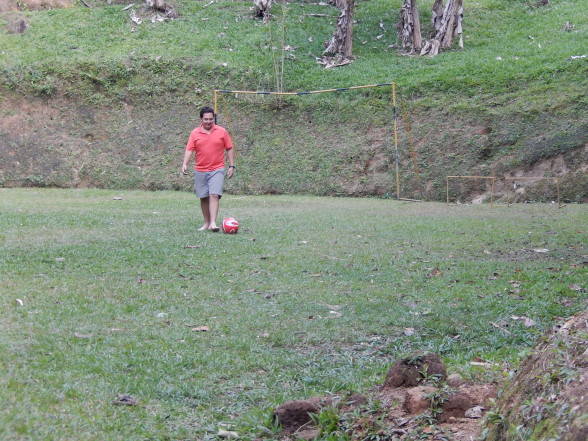
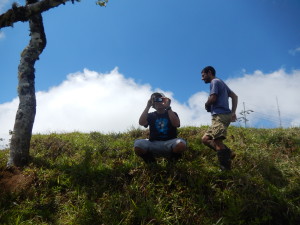 Not only are Costa Rican names as long as Jose’s, but all Costa Ricans are prone to giving nicknames to new people they meet. Mauricio’s is Mau(think cat call, or my personal favorite, like a cow moo), Jose’s is Tonio or more teasingly Takaco. I got a name very early on due to my UNC biology shirt. A bee was flying at me and I made a comment that it thought I was a flower. Pablo has christened me henseforth Floripondio.
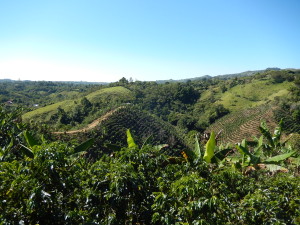 We started our survey by putting out tuna bait for carnivorous ant species and collected the ants that appeared after forty minutes. My survey site was at the far end of the plantation. I was required to crawl prone through a patch of coffee plants, placing baits along the way. Additionally, we collected 250 fallen coffee fruits to dissect later for evidence of beetle investation. When I came out of the tunnel I was greeted to a vista of the entire plantation, it was a moment of peace and reflection, because every piece of land and pasture was once old growth forest with wet soil and vibrant life. After collection we returned to el labortorio at la cruces and worked at identifying the genus of ant and sifting through our coffee beans and fruits. I am proud to be apart of real work that determines the livelihood of farmers here, and I will be involved in more projects later on in the semester.
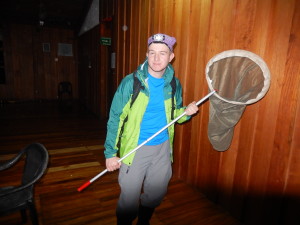 Always have your bug catching gear, and be prepared for rain!